
Help Desk
Ask a question and one our reps will assist you.
On the right of this Help Desk page, you will see many popular questions our clients ask us... Many of these are general commercial printing and graphic file prep questions. These answers were written by our Operations Manager, Ray West and his general knowledge of the printing industry for the last 25 years. You can email: ray@americasprinter.com or call him directly at 714.521.1100 ex 310. He is very pleasant and a wealth of knowledge to assist you with your graphic files and ultimately your print job... If you need additional information answered, please complete the request form below and selected either email or phone as your response preference. I or one of my team members will contact you shortly...
How do I create a PDF from Adobe Indesign
From Indesign files should be exported. In the menu, under file click on export, Save as Adobe PDF, Export Adobe PDF dialog box will appear, In the Adobe PDF preset select "Press Quality". In the options box on the left side select "Marks and Bleeds", For marks, Check crop marks. For Bleed, In the bleed area enter .125". Check export and a PDF - Press Quality will be created.
What file formats are acceptable
We accept a wide variety of file formats. Adobe Acrobat Document version 1.4 (.pdf) is the most recommended. Also accepted: Illustrator (.ai, .eps, .pdf) Photoshop (.psd, .tiff, .eps, .jpeg) Native application files are also eccepted: Indesign, Quark
What color mode should my files be?
Files should be CMYK if printing as 4 color process, Grayscale if printing as black and white. PMS if printing with spot colors. You may have a file that has all 3 color modes printing, If you were printing 5/1 for example. This might be 4 color process plus a 5th color PMS on the front and grayscale or black on the back.
What resolution do you recommend?
Images in color or black and white, should be 350dpi. bitmap files should be at least 900dpi
Does my file need bleed?
Yes, All files require bleed. Business cards need .05" on all four sides. All other files need .125" on all four sides
Are my files correct?
Please check your files for image resolution, bleeds, and fonts/text. Your files must be submitted at the correct size, including bleeds. Please make sure that all text is at least 1/8th inch (.125") away from the cut line and that all images and text are at least 350 dpi for rasterized images.
How do I create a PDF from Adobe Illustrator?
Save as Adobe PDF. In the save as dialog box the Adobe PDF preset should be set to press quality. Marks should be set for trim marks and bleeds should be set to .125". Output should be set to No conversion. Save PDF will create a press quality PDF.
What is the difference, Vector files vs. Raster Files?
What are Vector Images? Vector images use mathematical equations to define each component of an image. This allows vector images to retain their high-quality at any size. This is very good for text and graphics. When possible, use vector graphics created in a desktop publishing program. What are Raster Images? A raster image is composed of a collection of tiny dots called pixels. When these pixels are small, and placed close together, they fool the eye into forming a single image. Raster images work well when subtle gradations of color are necessary. Because they contain a fixed number of pixels, a major disadvantage of raster images is that their quality suffers when they are enlarged or otherwise transformed. They are also large in file size.
What is Rich Black
Rich Black is an ink mixture of solid black with additional CMY ink values. This will create a darker black then printing 100% black ink alone. We recommend printing 100K/50C/40M/25Y as a Rich Black.
What is a PDF
Portable document format or .PDF for short is a universal file format developed by Adobe Systems to preserve all fonts, formatting, graphics, and colors of any source document. PDF allows any file to be read by the Acrobat reader regardless of the hardware or software platform on which the file was created.
What makes a good PDF
What every PDF should have to make it a good PDF Simply using the proper design-oriented software doesn't guarantee print-perfect PDF files. Bad PDF files have been created from every application that can write PostScript or export PDF. Although there is no such thing as a typical print project, there are characteristics common to a print-viable PDF file. These include: •All fonts used are embedded. •All included bitmap images are of sufficient resolution for the final print method. •If compression is used for images, it is lossless (zip). •Illustrations are encoded as vector data: no erroneous conversion to bitmaps. •Colors are specified in the correct color space (as intended to print). •Physical dimensions of page size are correct and sufficient to include bleed objects. •There is a plan for how, when and where to flatten live transparent objects.
What does CtP mean
CtP means "Computer to Plate" We utilize Computer to Plate technology to produce all of our printing plates. This process eliminates the film and developing systems from prior years. Computer to Plate is better in many ways. First, we have eliminated the chemicals used to develop the film, and the film itself. These films also used silver as a material component. The process of transferring the image from the film onto the printing plate could leave room for errors and miss-registration of the image. The result is an image likened to photocopying an image. The quality and integrity of the image is compromised each time the image is transferred from one medium to another. With the development of Computer to Plate (CtP) the margin of error for miss-registration is practically eliminated. The images are registered by the computer and burned directly to the plate, allowing for precise screen angles and LPI's. Also, we use a Screen Javelin 8600S for our CtP processes. It allows for original imaging direct from the digital file. One of the features of the Javelin 8600S is the Automatic Inline Punch which provides perfect plate registration. Finally, thermal plates are our plate of choice. The sharp, hard edged dot from thermal plates ensure the highest quality possible from our presses. Standard CtP plates can have soft-edged dots and are prone to exposure and development variation. Thermal plates are a true digital plate. With thermal plates nothing is imaged until the laser reaches the specific temperature which raises the image on the plate.
How do I know my files will print correctly, as far as color?
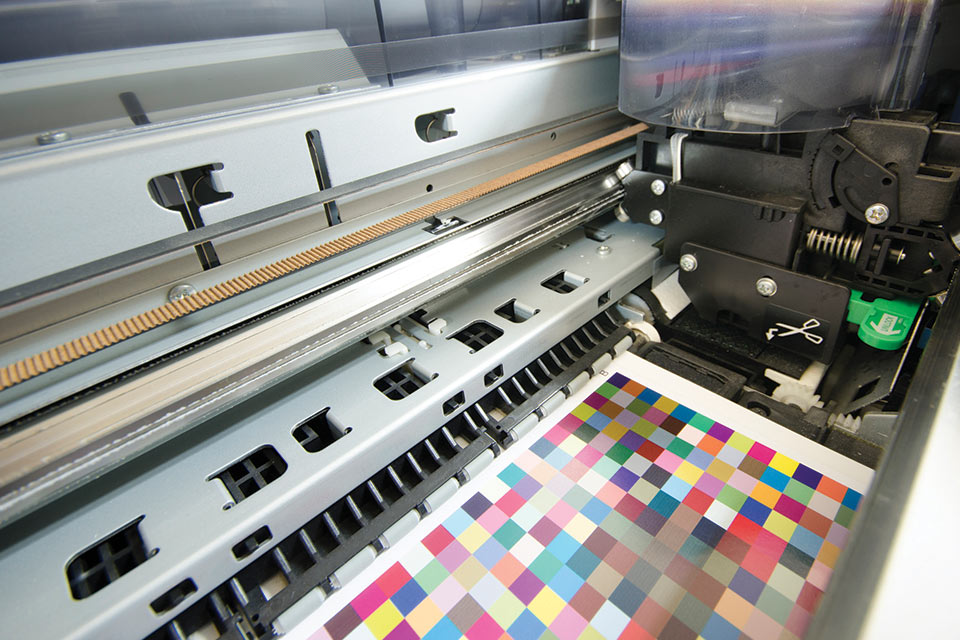
We recommend a hard proof for jobs that are mission critical, when it comes to color. You will receive a proof that you can review. Proofs are a good way to double check a product’s color, content and layout before it goes to press. Our proofing devices have been calibrated using Gracol 6 standards. GRACol stands for "General Requirements for Applications in Commercial Offset lithography. The standards are developed by a separate group called the Graphic Communications Association (CGA) This group is supported by the IPA and GATF.
What line screen does APC print?
Our line screen is 200dpi for all of our products.
File Preparation Tips
Provide all fonts with your job, including those used in EPS graphics. Supply all Mac supported PostScript Type 1 printing and screen fonts with the files. Provide all linking art (TIFF, EPS, etc.). Make sure the linking art is made with an appropriate resolution. (a.) 300 ppi for continuous-tone images (b.) 1200 ppi for line-art images Make sure the filenames of linking art match those called for in the layout files. Clearly label any elements that are "For Position Only." Make sure the document size of each layout file is the same as the desired flat trim size, plus .125" bleed on all four sides Make sure any element that is intended to bleed actually extends beyond the document edges. (Our standard bleed is 1/8-inch or .125".) Eliminate unused elements from the pasteboard or from hidden layers in your files. Eliminate unused or duplicate colors from each file. Eliminate all files that are not intended as part of the project. Do not define any rules as "hairline." If you want a very file rule, set it to 1/4-point. Set colors to CMYK or spot colors, not RGB.
I work in Photoshop. How can I keep my text sharp
When saving the file, save as PDF. Make sure the fonts are open and that you have both printer and screen fonts
What is Trapping?
Trapping digital files is the process of compensating for misregistration on the printing press by printing small areas of overlapping color where objects meet. This is best left to the prepress department.

What is creep?
Creep: In a saddle stitched booklet the bulk of the paper causes the inner pages to extend further out than the outer pages when folded. When trimmed the inner pages are narrower than the outer pages. Solution: If creep is noticeable, copy can be repositioned toward the center of the spread for those pages in the center of the booklet. When trimmed, all pages will have the same outer margins and no text or images are lost. Some page layout software can automatically calculate and adjust layouts for creep -- moving the page elements of affected spreads in small increments.
How to make gradations in photoshop
In Photoshop, add a small amount of noise to the image by doing one of the following: -- Add noise when creating the gradient by using the Dither option in the Gradient Tool Options dialog box. -- Apply the Add Noise filter to the image (choose Filter > Noise > Add Noise): - For a CMYK image, add noise to only the affected channels and set Distribution to Gaussian for the best results. Often, banding is prominent in only one or two channels, so it's not necessary to add noise to the composite image (i.e., to all channels). Additionally, noise added to only one or two channels is not as noticeable as noise added to all channels. The amount of noise you can apply before an image becomes grainy depends on the resolution of the image. For a 300 ppi image, for example, use a setting between 2 to 6. - For an RGB image, apply noise to only the gray values by selecting Monochrome in the Add Noise dialog box. (Noise added to gray values is less noticeable than noise added to RGB channels.) -- Convert a CMYK image to L*a*b color mode, then apply noise to the L (Lightness) channel. Also beware of RGB gradations: Often, gradients between RGB colors create values that are outside the CMYK gamut, or range. These out-of-gamut values may convert to the same in-gamut CMYK value, which may result in banding. Gradients created in CMYK mode are usually smoother because they have in-gamut values.
How to create files that will print
Print Ready Files - 5 Basic Steps to Get Your Files Ready for Print Getting your files ready for print is a fairly simple process when using a few guidelines from the very inception of the design project. Because today's modern digital printing can take advantage of camera ready files, the process is much more efficient. Basically, this just means that the printer is able to take the file you give them and immediately send it to the printing system - no edits or manipulations are needed to your file first. Here are the 5 basics of getting your files ready for print. Make Sure The Resolution Is Right For the best quality professional printing results, it's very important to keep the resolution as high as possible. For example, 300 dpi resolution is considered by most printers to be an absolute minimum. Also, it's important to do each step of the design process in the actual resolution you'll be submitting to the printer to avoid any loss of quality throughout the creative process. Make Sure The Colors Are Consistent Chances are, when you are editing an image on for viewing on your computer screen or on a web page, you're using the RGB color format. This is the format computers normally use to display colors. However, when printing accurately, it's important to utilize the CMYK color space option instead. Also, for sharp and crisp black, it's important to use 100% black with no additional CMY encoded (the K in CMYK stands for black). Follow Trim And Bleed Guidelines Bleed and trim are the terms used to describe the area around the dimensions of your final image that will be unsafe to use for important content in your design. In a nutshell, it's very important to leave about 1/4 of an inch from the edge of your dimensional content to the edge of any important lines of text or featured images. This area will be used as kind of a buffer zone in the printing process. Avoid Drastic Image File Compression The more you can avoid compressing your final design, the better. The recommended file format for saving a file is usually TIFF. This is because the TIFF file format keeps all color information and all pixel information from the original design intact. On the other hand, lossier image files, such as JPG and GIF, reduce file size by eliminating small portions of the image or by getting rid of some of the color information stored within the file. Better final results from printing happen when better quality images are put forth. Save In A Standard Format Once you've finalized your graphic design and text files, it's important to lock them in and place them in sort of a shelter that can be easily shared with the printer. One great way to do this is to use Adobe?Acrobat?PDF files. They're commonly used in the printing industry because they're cross platform compatible. Plus, using this type of standardized format doesn't allow for the possibility of accidental changes or edits to the camera ready image. Once it's "locked" and saved as a PDF file, how it is shown in that format is how it will be printed.
Can I supply PDF files
Yes, we can accept press-ready PDF files, including PDF/X-1a files. In fact, in many cases, we prefer them because we’re able to process your job right away, without much of the setup required for native files!
What is GRACol?
GRACoL stands for General Requirements for Applications in Commercial offset Lithography. The recommendations set by this organization allows for consistent reproduction of color across multiple presses. It is a comprehensive set of guidelines for planning and processing work for printers.
- How do I create a PDF from Adobe Indesign
- What file formats are acceptable
- What color mode should my files be?
- What resolution do you recommend?
- Does my file need bleed?
- Are my files correct?
- How do I create a PDF from Adobe Illustrator?
- What is the difference, Vector files vs. Raster Files?
- What is Rich Black
- What is a PDF
- What makes a good PDF
- What does CtP mean
- How do I know my files will print correctly, as far as color?
- What line screen does APC print?
- File Preparation Tips
- I work in Photoshop. How can I keep my text sharp
- What is Trapping?
- What is creep?
- How to make gradations in photoshop
- How to create files that will print
- Can I supply PDF files
- What is GRACol?